
Experience the Pixel PT in live operation at a leading logistics service provider
 Go back
 Experience the Pixel PT in live operation at a leading logistics service provider
 13 October 2026
  10:30–12:00
  Leading logistics service provider, border region of Bavaria and Upper Austria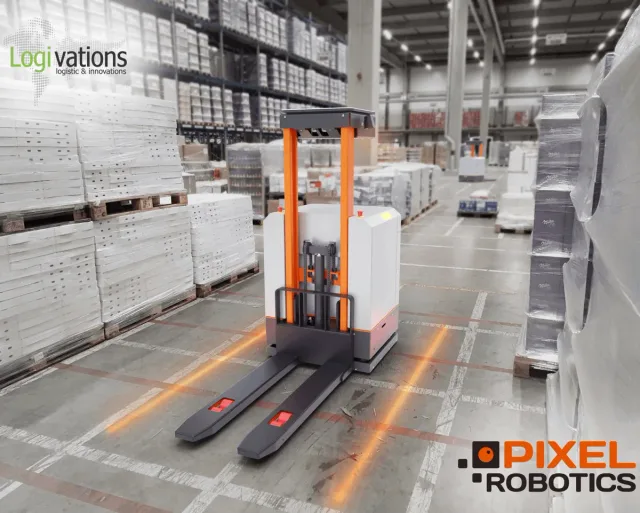
Find or contact us:


How does autonomous intralogistics work when people, forklifts and mobile robots share the same floor every day?
At this site you can see the Pixel PT where it matters: in real logistics operation. We show how autonomous pallet transports are integrated into existing processes and how camera and AI systems help to automate processes more flexibly.
The visit is aimed in particular at companies currently assessing which transports can be automated and how AMRs can be integrated into existing processes and IT systems.
What the installation delivers in continuous operation is described in our use case for this site: over 350,000 pallets transported fully automatically since going live in 2022.
Address, on-site contact and directions follow by email once your registration has been reviewed.
What you will see
Automatic order generation from the running process
The camera system identifies pallets ready for transport from a bird’s-eye view. Transport orders can therefore be created automatically, without each order being triggered manually.
Robots and staff in the same process
The Pixel PT is designed for hybrid operation. Recurring transports can be taken over by the robots, while staff continue to work flexibly in the same processes where needed.
The entire workflow therefore does not have to be aligned to the automation.
Dealing with real conditions
In daily operation, pallets are not always exactly in their intended position. The Pixel PT also detects pallets placed at an angle or offset and can pick them up.
Staff do not have to perfect their way of working for the robot.
Automatic identification and destination assignment
The system identifies pallets and labels and can reconcile the required information with the warehouse management system. The respective destination is then determined dynamically.
AI-based detection of forklift tines
A purpose-built detection allows the Pixel PT to identify forklift tines in its path and take them into account during navigation — including in conditions where conventional 3D sensors can reach their limits.
Fleet control at a larger scale
With several robots, productivity is not determined by the performance of a single vehicle alone. What matters is how orders are distributed, routes coordinated and mutual obstruction avoided.
On site we show how the Pixel PT interacts with other robots and with staff within a larger fleet.
Designed for daily output rather than top speed
A Pixel PT travels more slowly than a person with a manual forklift. In return, it can take over recurring transports continuously over many hours — at this site up to 21 hours per day.
For regularly recurring transports, what matters is therefore not the speed of a single run but the output across the whole operating day.
Further topics on site
Real-time digital twin
Besides the robots, the camera system also captures other relevant objects and movements in the hall. This produces an up-to-date digital image of the processes.
Fleet and floor management with W2MO
Together with our partner Logivations we show options for planning and controlling fleets and logistics areas.
Digital twin with W2MO
Physical processes and digital planning can be linked and used for analysis and optimisation.
Assessing a specific use case of your own?
Then please bring it along.
After the live demonstration there is the opportunity to discuss your processes directly with our team — for example transport distances, pallet types, interfaces, mixed operation or the economically sensible number of robots.
Attendance is free of charge.
Please bring safety shoes and a high-visibility vest — we will be walking through a live operation.
Registration
Please register using the form. After registering you will receive a confirmation by email; we will send the organisational details a few days before the visit.
Experience Pixel PT not in a demo, but in daily logistics operation.